It radically changed the way Saudi employers manage work permits and employment relationships.
If you are an employer, human resources manager, or government relations officer (PRO) operating within the Kingdom, understanding what an electronic power of attorney is, how it works, and its importance is no longer optional but essential. It is a fundamental part of complying with Saudi labor laws and the regulations of the Ministry of Human Resources and Social Development (MHRSD).
This article takes you on a comprehensive tour of everything you need to know — clearly and practically, away from the legal complexities that often make government procedures confusing.
What is E-Wakala?
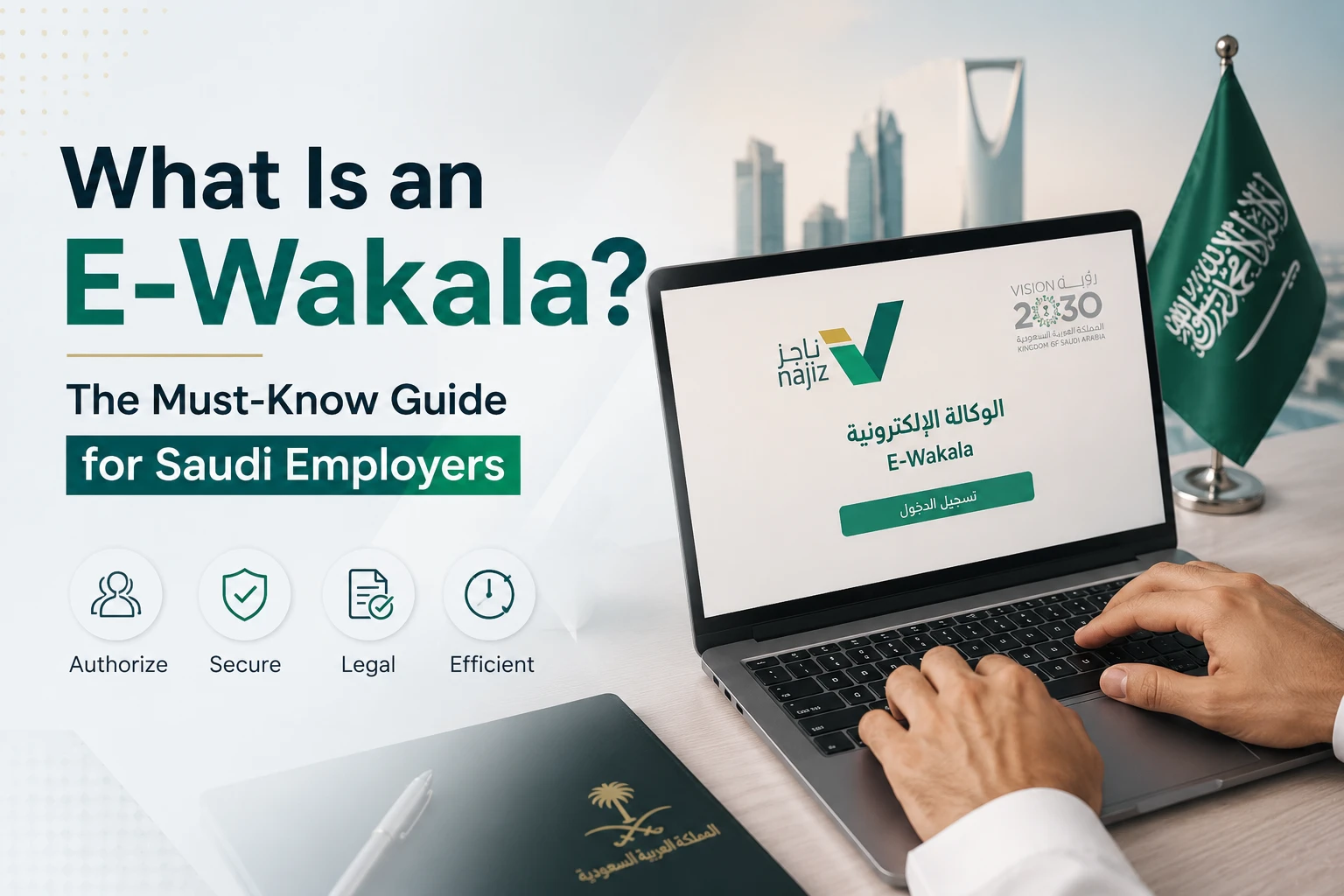
An electronic power of attorney (also spelled “electronic agency”) is a formal digital power of attorney issued through Saudi government platforms—primarily the Absher platform or the Ministry of Human Resources portal. The word “agency” in Arabic means authorization or delegation, and in the context of work and residency, it refers to a formal legal authorization that allows a designated representative to act on behalf of an employer or individual.
In practice, an electronic power of attorney for Saudi employers is an electronic document that authorizes a specific individual—often a typing center employee, a government official, or a licensed recruitment agency—to complete government transactions on behalf of the company. This includes submitting work visa applications, processing residency renewals, obtaining exit and re-entry permits, and handling other Ministry of Labor procedures.
Before this system was digitized, employers faced lengthy, time-consuming, and often delaying paperwork procedures. The electronic power of attorney system has replaced much of this bureaucracy with a streamlined digital workflow that can be initiated and verified entirely electronically.
Why is the E-Wakala system important for Saudi employers?
Saudi Vision 2030 has accelerated the digital transformation of government services, with the labor sector at the forefront of this transformation. This shift brings employers greater convenience and more precise accountability.
Here are the main reasons why electronic power of attorney is an indispensable tool for companies operating in the Kingdom:
Legal protection: By issuing an electronic power of attorney with specific powers, the employer retains control over the actions authorized to be carried out on his behalf, thus protecting him from unauthorized submissions or misuse.
Processing speed: Because everything is done electronically, visa and permit applications go through the system much faster compared to paper applications.
Transparency: Employers can track authorized and completed transactions through the same online portals, creating a clear audit record.
Delegation without attendance: The employer does not need to be physically present in government departments, as the authorized agent handles the transactions while the employer devotes himself to his other priorities.
For companies with a large workforce or a high turnover rate of foreign workers , the electronic power of attorney system becomes an indispensable operational tool.
How does E-Wakala work for Saudi employers?
Obtaining and using an electronic power of attorney is straightforward, but requires precision and attention. The detailed steps are as follows:
Accessing the Absher platform or the MHRSD portal
Employers access the electronic power of attorney system via Absher Business (Absher Business), Musaned platform for domestic workers, or MHRSD portal for commercial workers, using their data linked to their commercial record.
Choosing an authorized agent
The employer designates who will act on their behalf; this could be a sole employee, a printing center, or a licensed employment agency. The agent must possess a valid national identity number (for Saudis) or a residency permit number (for foreign residents).
Defining the scope of delegation
This is one of the most important steps. The employer specifies the types of transactions the agent is authorized to perform. For example, the power of attorney can be restricted to:
- Applying for new work visas
- Renewal of residence permits
- Processing exit and re-entry visas
- Employee sponsorship transfer (sponsorship transfers)
- Submitting or responding to labor complaints on behalf of the employer
The ability to restrict the scope of the electronic power of attorney is a very important feature, as it prevents agents from making substantial changes to the business without explicit permission.
Specify the expiration date
Each electronic power of attorney comes with an expiration date. The employer can specify the duration as needed—a single transaction or an ongoing arrangement for months or a year. Once expired, the power of attorney automatically loses unless renewed by the employer.
Confirmation and issuance of the power of attorney
After data entry and verification, the employer digitally approves the electronic power of attorney. The system generates an authorization record linked to the employer’s account and the agent’s ID, enabling the latter to log in to their Absher or MHRSD account and proceed with the authorized transactions.
Key documents and requirements
Before issuing the electronic power of attorney, employers must ensure the following are available:
- Valid commercial registration with the Ministry of Commerce
- Absher Business account linked to commercial registration
- National ID or residency number of the person to be authorized
- A valid GOSI (Social Security) account is required, as some transactions require proof of social security compliance.
- The Saudization (Saudization) classification system has been updated to avoid visa issuance restrictions.
Employers who fall below the required Saudization quotas may find that their ability to issue certain labor authorizations — including transactions related to electronic power of attorney — is temporarily restricted until they regain compliance.
Common uses of E-Wakala in Saudi companies
Understanding real-world scenarios where electronic authorization becomes necessary helps employers plan ahead. Here are some of the most common cases:
Seasonal or large-scale recruitment: Companies operating in the construction, hospitality, retail, and manufacturing sectors that regularly recruit foreign workers rely heavily on electronic agencies to efficiently manage large visa payments.
Employers outside the Kingdom: An employer residing outside the Kingdom can manage all work transactions remotely by issuing a power of attorney to a trusted representative within it.
Domestic worker recruitment: For employers who sponsor domestic workers such as housemaids, drivers, and cooks, the Musaned platform uses its own version of electronic authorization to manage recruitment agency authorizations.
Legal and compliance work: Law firms and government official services that manage labor compliance for multiple companies receive electronic powers of attorney from each client company, enabling them to act on its behalf through various government portals.
Restrictions and risks that employers should be aware of
Despite the significant advantages of electronic power of attorney systems, employers should use them with caution. Several risks are associated with mismanagement:
Excessive authorization: Granting an agent broad powers may lead to unauthorized transactions, such as transferring an employee’s sponsorship without the employer’s knowledge.
Expiration of the power of attorney and the delays it causes: If the employer forgets to renew the power of attorney and there is an urgent transaction pending, this may result in fines or the expiration of workers’ visas .
Unlicensed agents: Using unlicensed printing centers or unreliable agents increases the risk of fraud. Always verify that the recipient of the power of attorney is a licensed professional.
Data sensitivity: Because the electronic power of attorney is linked to sensitive government accounts, employers should treat Absher data with the same degree of care as bank account data.
The role of E-Wakala in the sponsorship and care transfer system
One of the most prominent areas where e-powers play a pivotal role is the sponsorship system. Under Saudi labor law, every foreign worker must be sponsored by a Saudi employer—a requirement that is part of the recruitment process for foreign workers . When a worker wishes to transfer their sponsorship to a new employer, both parties—the current and new employers—must interact through the MHRSD portal. E-powers ensure that authorized agents can complete the paperwork on behalf of either party, simplifying what can otherwise be a complex process.
With recent reforms to the sponsorship system under Vision 2030, workers now have greater flexibility to change jobs under certain circumstances. These changes have made the accurate and timely management of electronic power of attorney more important than ever, as employers must respond quickly to transfer requests to remain compliant.
Frequently Asked Questions (FAQs)
Q1. What is an electronic power of attorney in the Kingdom of Saudi Arabia?
An electronic power of attorney is an official digital document issued by a Saudi employer through the official portal of the Ministry of Foreign Affairs, authorizing a licensed recruitment or visa agency to complete work visa procedures on behalf of the company. It allows the agency to legally execute recruitment procedures and stamp the visa on behalf of the Saudi employer.
Q2. Who issues the electronic power of attorney — the employer or the employee?
The electronic power of attorney must be issued by a licensed Saudi employer. The employee cannot issue it themselves. It is the employer’s (or sponsor’s) responsibility to generate it through the official government portal and share the visa authorization number with the designated agency.
Q3. What platform is used to issue the electronic power of attorney?
Electronic power of attorney documents are issued digitally through the Saudi Ministry of Foreign Affairs’ online platform (visa.mofa.gov.sa). The power of attorney includes details such as the visa number, the sponsor’s ID number, and the name of the agent or the authorized agency.
Q4. What information should be included in an electronic power of attorney?
The electronic power of attorney must include specific details such as the visa authorization number, job title, and the name of the authorized agency. It is often certified by the Saudi Chamber of Commerce to confirm its validity.
Q5. Can the electronic power of attorney be issued directly in the employee’s name?
Yes, in some cases. The power of attorney is issued directly in the applicant’s name if there is no overlapping agency, particularly in countries with limited agency services like Australia. However, in countries like India, Pakistan, and Nepal, it must be in the name of a government-approved employment agency.
Q6. What are the requirements of the Saudi company for issuing an electronic power of attorney?
The sponsoring company must have a valid legal and commercial presence in Saudi Arabia to issue the power of attorney, and must possess a visa quota from the Ministry of Interior. Furthermore, employers must maintain a green or platinum Nitaqat rating to avoid delays or rejection.
Q7. How long does it take to approve an electronic power of attorney?
Approval of the agency in Saudi Arabia usually takes 7 to 15 working days, after which the employer receives a visa authorization number which is shared with the employee or agency to begin visa procedures from their country.